
Sustainability in your contract stack

The “contract” is rarely a single document. It is a CONTRACT STACK.
A contract is rarely just the main agreement. It usually includes several appendices, such as product or service specifications, general terms and conditions, (Supplier) Codes of Conduct, company policies, and sometimes even emails or requests for proposal responses. If you don’t map this package, the contract stack, you risk gaps and inconsistencies.
Most sustainability content isn’t in the main contract document. It is in the appendices: product/service specifications,general terms and conditions (GTCs), Supplier Codes of Conduct (SCoC), supplier requirements, and policies. These documents may appear under different names (for example, Business Partner Code of Conduct, Code of Ethics, or Supplier Standards).
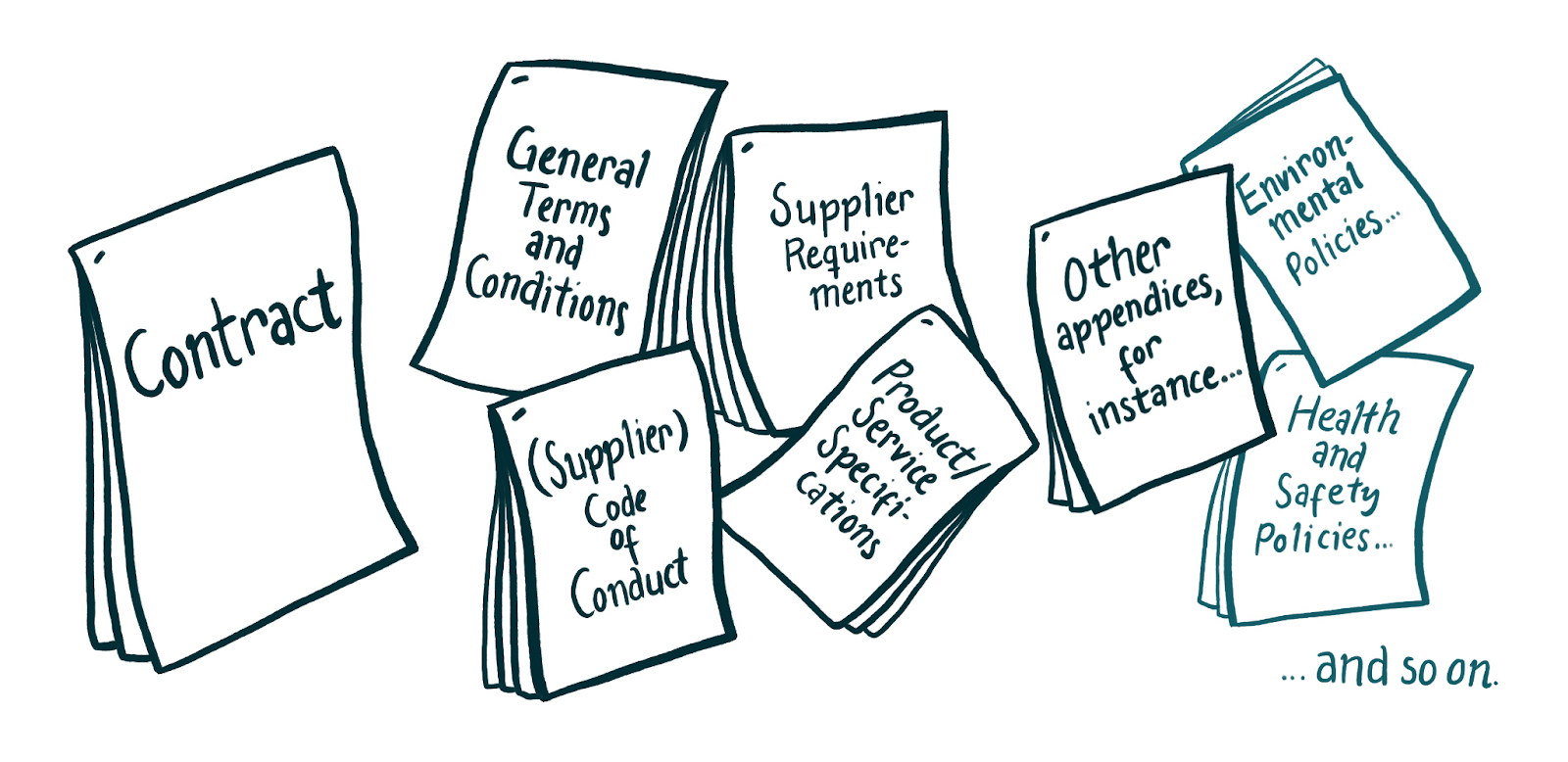
The contract stack extends even beyond the documents listed above. Documents in the contract stack often reflect and refer to internationally recognised principles (such as the UN Guiding Principles on Business and Human Rights, the OECD Guidelines for Multinational Enterprises and the ILO Core Labour Standards) as well as management system standards (such as ISO 9001 for quality management, ISO 14001 for environmental management and ISO 45001 for occupational health and safety), which provide structured processes for managing risks, monitoring performance and continuous improvement. Through Supplier Codes of Conduct and Supplier Requirements, these references may translate into supply chain commitments, expressed as expectations or contractual requirements for suppliers and sometimes passed cascaded further on to their suppliers and subcontractors.
The contract stack also operates within a broader legal environment. Applicable law and regulatory requirements continue to apply whether or not they are explicitly mentioned in the contract.
Remember! Your “contract stack” may include:
- Main contract document: The core agreement
- General Terms and Conditions (GTCs): Standard terms that apply across relationships
- Product or service specifications. Technical and performance requirements, including concrete sustainability criteria
- Supplier Code of Conduct (SCoC): Sustainability standards and expectations regarding human rights, environment, and good governance
- Supplier Requirements: Technical and operational requirements designed to translate sustainability standards into practice more specific, sector-tailored obligations
- Policies: Internal documents that set out a company’s principles, commitments and rules on specific topics (such as environment, health and safety or anti-corruption).
- Internationally recognised principles and standards: The UN Guiding Principles on Business and Human Rights, the OECD Guidelines for Multinational Enterprises, the ILO Core Labour Standards, ISO standards
- Applicable law